
Socialising and socialisation are not quite the same thing
I use these two words slightly differently because it gives owners a useful way to think about the job. It is not a formal scientific distinction, but it helps.
When people talk about socialising a puppy, they often mean interaction with people or other dogs. Socialisation is much broader. Your puppy is also learning about traffic, flooring, noises, movement, travelling, household objects, handling, frustration, excitement, new places and the rather odd things humans treat as completely normal.
A puppy sitting beside you while a buggy rattles past is having a socialisation experience. So is the puppy investigating a cardboard box, balancing carefully over a safe low surface, travelling in the car, or noticing another dog without going anywhere near them. Nothing spectacular has to happen for useful learning to take place.
Why “meet everyone” is not the goal
One of the easiest ways to make puppy socialisation harder than it needs to be is to treat every person or dog as somebody your puppy ought to greet. Some puppies adore that arrangement. Others tolerate it, some become overwhelmed, and even the very sociable ones can learn an inconvenient lesson: every interesting creature I see might be available to me.
That expectation can become awkward later, particularly when the puppy is bigger, stronger and frustrated because today they are not allowed to charge over to the dog on the opposite pavement. I would much rather teach a puppy that dogs and people can simply exist in the environment. Sometimes we interact. Often we do not.
What the research can actually tell us
Early experience matters, but the evidence does not support a magic checklist. A 2022 puppy study by Stolzlechner, Bonorand and Riemer gave very young puppies carefully graded experiences with novel objects, sounds and simple problem-solving tasks. At six to seven weeks the treatment puppies were bolder towards a novel object, startled less, recovered faster after a loud noise and persisted more with the problem-solving task.
That sounds impressive, but the longer-term result is just as important. At six months, the researchers did not find differences between the groups on owner-reported personality measures. In other words, thoughtful early experiences can influence how puppies respond in the moment, but a few carefully chosen exercises do not manufacture a permanently confident adult dog.
A newer study, published in 2026, also gives us a useful piece of the puzzle. Csepregi and colleagues found that puppies under six months were already showing attachment-specific preferences towards their owners in two of the three comparisons they examined. Feeling secure with you and feeling confident with unfamiliar people are therefore not the same thing, and a puppy does not need to choose a stranger over you to prove they have been properly socialised.
A broader 2022 review of canine socialisation research reached another helpful conclusion: there is far less modern experimental evidence behind some of the very prescriptive advice given to puppy owners than the confidence of that advice might suggest. That is a good reason to keep principles flexible and look at the puppy in front of us rather than worshipping a checklist.
What useful puppy socialisation can look like
The practical part is pleasantly ordinary. You do not need to turn every day into an expedition, and you certainly do not need a puppy itinerary. Small experiences, chosen well and stopped before your puppy has had enough, can do a lot of work.
1. Have a car picnic
Drive somewhere interesting, park safely and spend a few minutes doing very little. Your puppy can watch people, traffic, bicycles or dogs at a comfortable distance while they eat something, sniff the air or simply sit with you. You have introduced a new environment without asking them to march through it.
For puppies who are not yet walking in public areas because of vaccination considerations, follow your vet’s advice about local infectious-disease risk. You can still create useful experiences without putting your puppy on the ground everywhere.
2. Carry them and let them look
A properly supportive sling or carrier can be useful for a smaller puppy, particularly in the early weeks. Go somewhere for a short visit and let them take in the movement, sounds and smells. They do not need to meet the people they see, and they certainly do not need to be passed around.
3. Practise watching the world go by
This may be one of the most useful things you can do. Sit on a bench, stand near the edge of a park or find somewhere with enough going on to be interesting without being overwhelming. Your puppy can watch children, delivery vans, dogs, joggers, shopping trolleys and the occasional wheelie bin that appears to have been designed specifically to offend dogs.
There does not need to be an interaction at the end of every observation. “I saw that and nothing happened” is useful information.
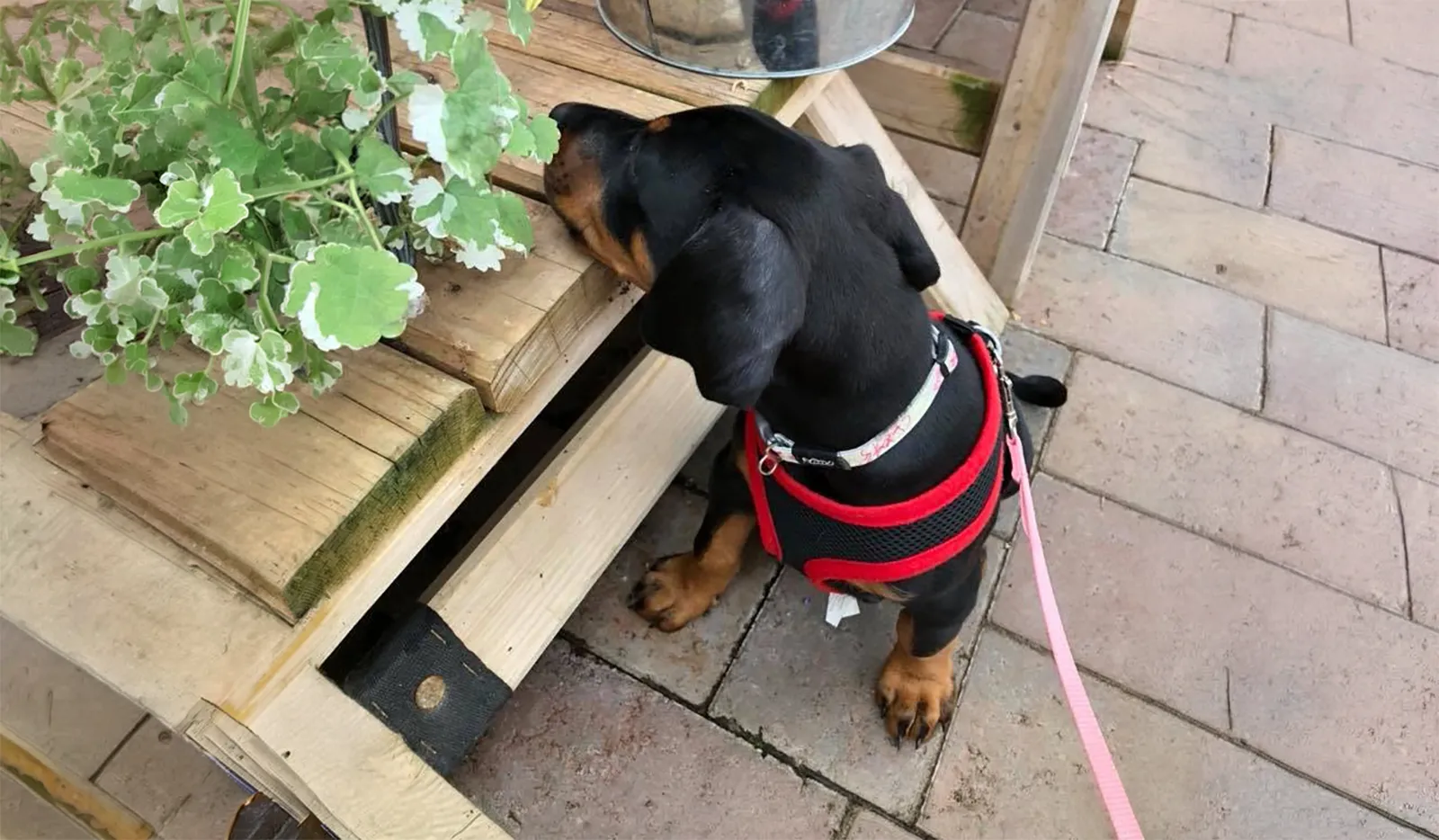
4. Visit dog-friendly places without creating a meet-and-greet
A dog-friendly shop can offer automatic doors, unusual flooring, trolleys, voices, shelves and people appearing around corners. That is already a lot to process. If your puppy wants to greet an appropriate person, fine. If they prefer to look from beside you, that is useful too.
Your puppy is allowed to approach, pause, move away or change their mind. Socialisation should leave room for those choices.
5. Make home physically interesting
You do not have to leave the house to work on socialisation. Give your puppy safe opportunities to investigate different textures and simple movement problems: carpet, grass, wood, rubber, a crinkly surface, a stable low platform, something to step over or an object they can work out how to move around.
The aim is not puppy parkour. Keep everything age-appropriate, low risk and easy enough that your puppy can think rather than panic. They are learning how their body works as well as how the world works.
6. Do not make on-lead play the default
This is a training preference rather than a scientific law, but it is one I find extremely useful. On an ordinary lead, I would rather a puppy learn that seeing another dog usually means we notice them and carry on, not that we pull towards them because play is about to begin.
Real life is messy, of course. If you are stuck on a narrow path and a quick, appropriate hello is the sensible option, say hello and move on. I am not trying to ban greetings; I simply do not want every dog to become an invitation.
For proper play, choose safe situations where dogs have room to communicate and move. That might be an appropriate secure area, or a carefully managed long line when the environment and the dogs make that suitable.
7. Choose quality over a revolving door of dog friends
While a puppy is still learning about canine communication, dogs you know can be extremely valuable. Look for dogs who are socially appropriate, can disengage, will not repeatedly bowl the puppy over and are comfortable when the puppy needs space.
Your puppy can still see unfamiliar dogs. They just do not need to meet all of them. A handful of good experiences is far more useful than a string of chaotic ones simply because somebody said puppies need to meet lots of dogs.
8. Play with your puppy outside
This is the bit I think we have lost. I see plenty of people walking dogs and plenty of balls being thrown, but surprisingly little actual play between dogs and their people once they step outside the front door.
Take a tug toy. Run away and let your puppy chase you. Hide briefly behind a tree, investigate something together, scatter a few pieces of food in the grass, practise three recalls or do a tiny training session and then go back to sniffing. None of it needs to last long.
Outside does not have to mean walking from A to B while the interesting world happens around you. Your puppy can learn that you are part of the interesting stuff too, which becomes very useful later when the environment is competing hard for their attention.
What still counts as socialisation?
More than most people think. A puppy can have a useful socialisation experience without touching, greeting or playing with anybody.
-
Watching from a distance.
-
Choosing whether to approach.
-
Moving away when they have had enough.
-
Checking in with you.
-
Playing with you somewhere new.
-
Seeing another dog without meeting them.
-
Travelling in the car.
-
Visiting somewhere and simply observing.
-
Visiting somewhere and simply observing.
-
Investigating a novel object or safe surface.
-
Solving a small, age-appropriate problem.
-
Meeting one suitable dog rather than six random ones.
-
Having a brief positive interaction with a person.
-
Declining an interaction altogether.
-
Sniffing and exploring a new place at their own pace.
Useful experience, not maximum interaction
The goal is not a puppy who loves everybody, nor is it a puppy who has collected a hundred strangers before breakfast. We are trying to help a young dog discover that the world contains lots of different things and that they have ways to cope with them.
They can look and investigate, play when it feels right, move away when it does not, and come back to you when they need help. Most importantly, they do not have to interact with everything they see.
Good socialisation might be a brilliant game one day and a strange surface the next; it might be a dog they know or ten quiet minutes in the car watching people go past. On another day, the most useful thing you can do may be to sit beside your puppy and let the world happen without asking them to join in.
Want some help getting your puppy off to the right start?
Puppy First Steps is my six-week puppy course at Lupo Academy. We work on the foundations that make everyday life and future training easier, including confidence, communication, focus, recall, lead skills and appropriate social experiences.
Sources and Further Reading
Optimising Puppy Socialisation – Short- and Long-Term Effects of a Training Programme during the Early Socialisation Period.
Animals, 12(22), 3067.
https://www.mdpi.com/2076-2615/12/22/3067
Human-analogue age-related dynamics of dog–human attachment.
GeroScience. Published 21 August 2026.
https://link.springer.com/article/10.1007/s11357-026-02482-7
Canine Socialisation: A Narrative Systematic Review.
Animals, 12(21), 2895.
https://www.mdpi.com/2076-2615/12/21/2895
Educational Disclaimer
This article provides general educational information about puppy development and training. Individual puppies differ in their health, behaviour, development and circumstances. Owners should speak to their vet about vaccination, infectious-disease risk or any health concern, and seek appropriate professional support if a puppy is persistently fearful or struggling to cope with everyday situations.
